Something is off in your school.
You might notice it in different ways:
Most schools reach out at this point. And that makes sense. When something breaks down, you look for a way to repair it.
But what we have learned is this: The issue is rarely the moment itself. It’s the container around it.
When the conditions for honest communication, trust, and shared accountability aren’t in place, even the best interventions fall short. Conversations don’t go deep enough. Agreements don’t hold. People leave the room without real shift.
So while schools often come to us because something went wrong, we don’t start with the incident. We start with the conditions.
Most restorative justice training focuses on tools — circles, conferences, scripts for difficult conversations. Those tools matter. But tools only work when the relational foundation is strong enough to hold them.
Before a school can repair harm, it needs:
That foundation is what we call the container. And building that container is Tier 1 work.
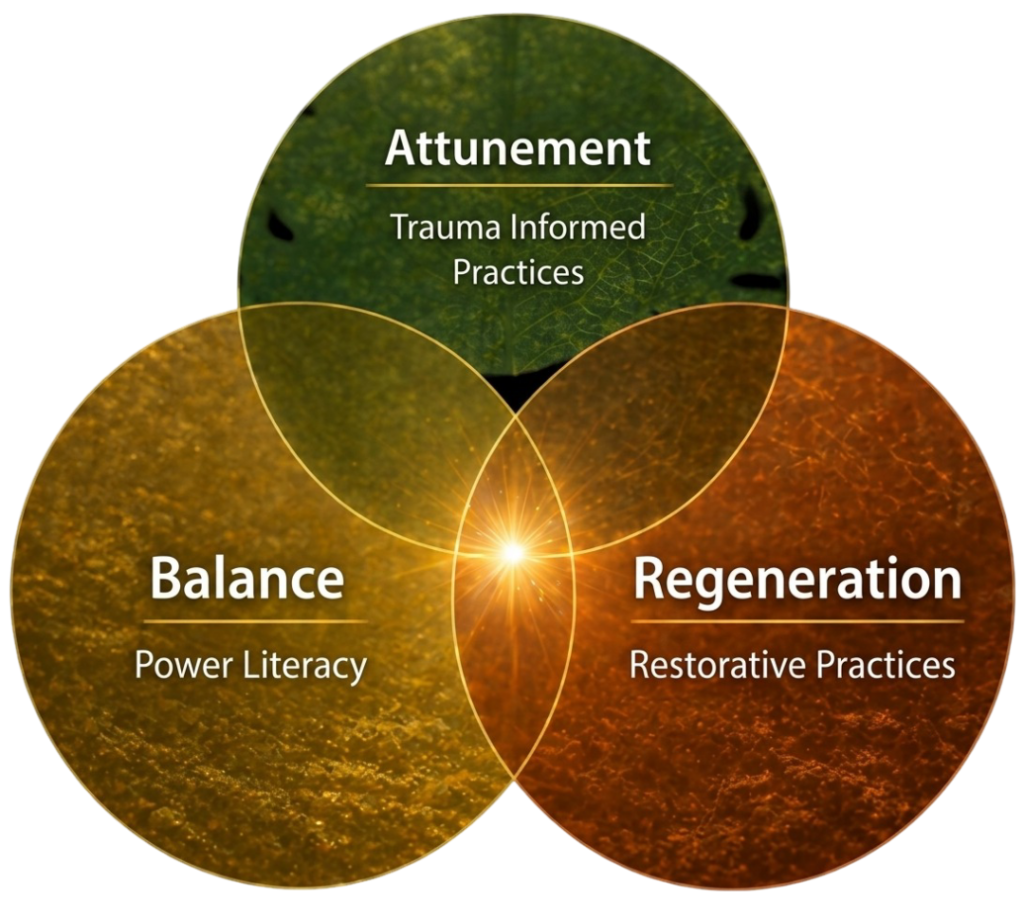
All of our work is guided by the Restorative Ecological Model (REM), which understands school communities as living systems — interconnected, layered, and capable of regeneration when the conditions are right.
We don’t do one-off trainings and walk away. We work in partnership — with teachers, administrators, counselors, and leadership — because culture shift requires the whole system.
Our engagements typically include:
We move at the pace of your school’s readiness — not a predetermined timeline.
Restorative practices are increasingly common in schools. How they are practiced varies widely.
At TTP Global, we lead with conditions, not compliance. That means:
We measure success in what holds over time.
Dr. Congrave Wilson has been an invaluable asset to our educational community at Steindorf STEAM School, where she collaborated with us to implement Restorative Practices. Her commitment to fostering a positive and inclusive learning environment has significantly impacted our school community.
As the founder of the Town Project, Dr. Congrave Wilson has demonstrated an unwavering passion for creating positive change within educational settings. Her expertise in Restorative Practices has been instrumental in training our teachers, providing them with the necessary tools to build strong, supportive relationships with students, and creating a culture of empathy and understanding.
What sets Dr. Congrave Wilson apart is her ability to tailor her approach to meet the unique needs of each educational institution. Her workshops are informative and engaging, fostering a collaborative spirit among educators and inspiring them to implement Restorative Practices in their classrooms.
Furthermore, Dr. Congrave Wilson’s commitment extends beyond the initial training sessions. She has been readily available to talk with me and provide ongoing support and guidance, ensuring a seamless integration of Restorative Practices into our school’s ethos. Her dedication to continuous improvement and genuine concern for the well-being of students and staff members have left an indelible mark on our school community.
I wholeheartedly endorse Dr. Sherry Congrave Wilson and the Town Project. Her contributions to our school have been transformative, enhancing the educational experience for students and educators alike. I do not doubt that her passion and expertise will continue to impact educational communities positively.









These challenges rarely exist in isolation.
They are signals that the ecosystem itself needs attention.
Rather than asking, “How do we fix this behavior?” we ask:
What conditions produced this outcome—and what conditions need to change?